
How to explain perimeter to a child: trace the edge, then add the sides
By 15Q20M Editorial · Last updated
Explain perimeter as the distance around a shape. Have your child trace the edge with a finger, measure each side, and add every side. A 9 by 6 inch rectangle has a perimeter of 9 + 6 + 9 + 6 = 30 inches. Area is a different measure: it counts the squares that cover the inside.
On this page
- How do you explain perimeter to a child?
- What is the difference between perimeter and area?
- How do you check perimeter homework?
- How do you find a missing side when you know the perimeter?
- What perimeter mistakes do kids make?
- Is it normal for a child to mix up perimeter and area?
- What grade do kids learn perimeter?
- What can you do tonight?
How do you explain perimeter to a child?
Here's a homework moment you may recognize. The page says "Perimeter of 9 × 4 cm" and your child writes 36. That's the area, not the distance around it. Before any formula, give your child a rectangle to hold: a book, a placemat, or a cereal box. The numbers below are for a 9 by 6 inch rectangle, the same one Day 72, Question 1 of our Grade 4 workbook asks about. If you measure your own, use your numbers.
| You say | Child does or says |
|---|---|
| "Put your finger on one corner and trace all the way around until you get back to that corner." | Traces the edge. "That trip around the edge is the perimeter." |
| "How many sides did your finger travel along?" | "Four." |
| "Draw a quick sketch of it. Measure each side and write the number next to that side." | Writes 9, 6, 9, 6 around the sketch. |
| "Now add all four numbers." | "9 + 6 + 9 + 6 = 30. Thirty inches." |
| "Which sides match?" | "The two long ones match, and so do the two short ones. So it's 9 + 6, which is 15, and then double it: 30." |
| "Lay your hand flat on the cover. Is that the perimeter?" | "No. That's the inside." Then you say: "The inside is the area. We count it in squares, not in inches along the edge." |
The fifth line is the shortcut your child will see in class: perimeter of a rectangle = 2 × (length + width). Day 57, Question 9 asks why it works, and the answer is that a rectangle has two lengths and two widths. A square has four equal sides, so its perimeter is 4 × side.
Perimeter starts in Grade 3 of the Common Core, under a heading that asks students to "recognize perimeter as an attribute of plane figures and distinguish between linear and area measures."
What is the difference between perimeter and area?
Perimeter is a length: how far it is around the edge. Area counts the unit squares that cover the inside. The fastest way to show the difference is to use one shape for both. Day 59 does exactly that with a rectangle 7 cm long and 4 cm wide: a flower bed in one question and a garden in the next.
| Perimeter | Area | |
|---|---|---|
| What it measures | The distance around the edge | The space inside, counted in unit squares |
| 7 cm by 4 cm rectangle | 7 + 4 + 7 + 4 = 22 cm (Day 59, Q8) | 7 × 4 = 28 square cm (Day 59, Q7) |
| Unit in the answer | cm, in, m, ft | square cm, square in, square m, square ft |
| A job that needs it | Fence for a yard (Day 63, Q10) | Carpet for a floor (Day 63, Q9) |
To show that the two measures are separate, cut a piece of string 12 inches long and tie the ends. On grid paper with 1-inch squares, stretch it into a 5 by 1 rectangle, then a 4 by 2, then a 3 by 3. Each time, the string is the perimeter, still 12 inches. Count the squares inside: 5, then 8, then 9. Same perimeter, different areas. Day 59, Question 10 asks about this: when two rectangles have the same perimeter, the area can still be different.
How do you check perimeter homework?
Check in this order, before you redo any arithmetic.
- Look at the unit in the answer. A perimeter answer is in plain units (cm, in, m, ft). If it says square units, your child found the area.
- Count the sides your child added. A rectangle has four. If only two numbers were added, two sides are missing.
- For a word problem, ask: "Is this a fence or a carpet?" Fence, border, frame, and trim go around the edge. Carpet, tile, paint, and grass cover the inside.
- Look for an edge that changes. A gate is a gap in the fence, so it comes off. A border around a picture sits at both ends of every side, so add the border width twice to the length and twice to the width.
Two problems from Day 57 test step 4. A garden is 12 m by 5 m, so the fence around it would be 34 m, but a 3-meter gate replaces part of one side: 34 − 3 = 31 m of fence panels (Question 14). A picture frame is 13 cm by 7 cm with a 2 cm border all around (Question 11). The border adds 2 cm at each end, so the outer rectangle is 17 cm by 11 cm and its perimeter is 56 cm. A child who adds 2 only once gets 15 by 9 and a perimeter of 48.
How do you find a missing side when you know the perimeter?
Cut the perimeter in half first. Half the perimeter is one length plus one width. Day 57, Question 10 gives a perimeter of 20 cm and a width of 4 cm. Ask: "What do one length and one width add up to?" Half of 20 is 10. "10 is 4 plus what?" 6, so the length is 6 cm.
Two of the wrong choices are the two halves of the method done alone. 16 cm comes from 20 − 4, subtracting the width without halving. 10 cm comes from halving and then stopping. To check any answer, put it back in: 6 + 4 + 6 + 4 = 20. If your child wrote 16, the check gives 16 + 4 + 16 + 4 = 40, which is not the perimeter in the problem.
Standard 4.MD.A.3 asks Grade 4 students to "Apply the area and perimeter formulas for rectangles in real world and mathematical problems."
Try it tonight
Can your 4th grader solve these 3?
Hand them the phone. It takes a couple of minutes, and you'll see exactly which one trips them up.
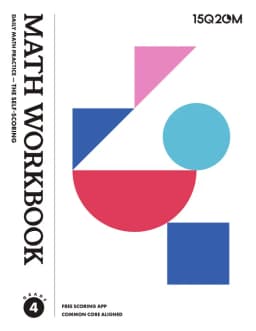
1A rectangular garden has a length of 16 m and a perimeter of 50 m. What is the width of the garden?
2A rectangular deck is 14 m long and 8 m wide. A path 1 m wide is built around the outside. What is the perimeter of the outer edge of the path?
3A yard is 10 m long and 8 m wide. A 2-meter gate is built into one side. How many meters of fence panels (not including the gate) are needed?
What perimeter mistakes do kids make?
| Mistake | Where it shows up | How to catch it |
|---|---|---|
| Multiplying the length and width | "36 cm" for a 9 by 4 cm rectangle (a wrong choice in Day 57, Q7) | Ask what the unit should be. 9 × 4 = 36 counts squares inside, which is area. The perimeter is 26 cm. |
| Adding only two sides | "13 cm" for the same rectangle (Day 57, Q7) | Trace the edge and count the sides your finger travels: four. 13 is half the trip. |
| Doubling only one side | "18 cm" for the same rectangle (Day 57, Q7) | Write all four side lengths on a sketch before adding: 9 + 4 + 9 + 4. |
| Treating a square as two sides | "12 cm" for a 6 cm square (Day 57, Q8) | A square has four equal sides: 4 × 6 = 24 cm. |
| Area units on a perimeter answer | "24 sq in" for the frame around a 6 by 4 inch photo (Day 63, Q8) | A frame goes around the edge, so the answer is in inches: 20 in. |
Some kids learn a rule like "area means multiply, perimeter means add." It works as a shortcut for rectangles, but other shapes use other area formulas: a triangle, for example, is base × height ÷ 2. And the rule says nothing about what each measure means. The finger trace and the unit check last longer.
Is it normal for a child to mix up perimeter and area?
Yes. Telling a length from an area is its own Grade 3 goal in the standards, and Grade 4 returns to both in word problems. If your child mixes them up on a worksheet but gets them right after tracing the edge, the idea is still forming.
It's worth a closer look if your child still can't say whether a fence or a carpet needs the edge after you trace a real object together, or if the trouble is the adding itself: when 9 + 6 + 9 + 6 comes out different each time, practice the addition separately before going back to shapes.
What grade do kids learn perimeter?
In the Common Core, perimeter starts in Grade 3. Standard 3.MD.D.8 covers finding a perimeter from the side lengths, finding an unknown side, and showing rectangles with the same perimeter and different areas. In Grade 4, standard 4.MD.A.3 applies the area and perimeter formulas for rectangles in real-world problems.
States and schools arrange this differently, so check your child's own unit list. North Carolina's 2023 at-home guide for families, for example, lists fixed-perimeter and fixed-area problems as a Grade 4 goal. In the Common Core, those problems are part of 3.MD.D.8 in Grade 3, and Grade 4 applies the rectangle formulas.
What can you do tonight?
- Pick one rectangle in the room and run the six-line script above. It takes about five minutes.
- Ask one "fence or carpet?" question about something in your house: baseboard, a rug, a picture frame, a tabletop.
- Try the three workbook problems on this page and check the units in each answer.
What 4th grade math covers under Common Core, including area and perimeter
Frequently asked questions
Is the perimeter always 2 × (length + width)?
For rectangles, because they have two equal lengths and two equal widths. A square is a rectangle with all four sides equal, so it becomes 4 × side. For any other polygon, add the length of every side.
Why is area in square units but perimeter is not?
Perimeter measures a length along the edge, so it uses units like inches or centimeters. Area counts unit squares that cover the inside, so it uses square inches or square centimeters.
Can two shapes have the same perimeter but different areas?
Yes. A 12-inch loop of string makes a 5 by 1 rectangle with an area of 5 square inches, a 4 by 2 with an area of 8, or a 3 by 3 with an area of 9. The perimeter stays 12 inches each time.
Common Core State Standards © Copyright 2010. National Governors Association Center for Best Practices and Council of Chief State School Officers. All rights reserved.
15Q20M is an independent product and is not affiliated with, sponsored, or endorsed by NGA Center or CCSSO.
Sources
- Common Core State Standards for Mathematics (combined PDF), 3.MD.D, 3.MD.D.8, 4.MD.A.3 — p.25, 3.MD.D heading: "Geometric measurement: recognize perimeter as an attribute of plane figures and distinguish between linear and area measures." p.25, 3.MD.D.8: "Solve real world and mathematical problems involving perimeters of polygons, including finding the perimeter given the side lengths, finding an unknown side length, and exhibiting rectangles with the same perimeter and different areas or with the same area and different perimeters." p.31, 4.MD.A.3: "Apply the area and perimeter formulas for rectangles in real world and mathematical problems." (verified 2026-10-16)
- NC Department of Public Instruction, Rethink Education: An At-Home Guide for Families, 4th Grade Math in North Carolina Public Schools (2023) — p.2, course outline: "Solve problems involving a fixed area and varying perimeters and a fixed perimeter and varying areas." p.13, glossary: perimeter is "The distance around the outside of a shape measured in linear units"; area is "The measure of space inside a figure measured in square units." (verified 2026-10-16)
- 15Q20M question bank (Grade 4 workbook) — Day 57 Q7: perimeter of 9 × 4 cm is 26 cm (wrong choices 13, 36, 18). Day 57 Q8: perimeter of a 6 cm square is 24 cm (wrong choices 12, 36, 6). Day 57 Q9: P = 2 × (l + w) because there are two lengths and two widths. Day 57 Q10: perimeter 20, width 4, length 6 cm (wrong choices 16, 10, 5). Day 57 Q11: 13 by 7 cm frame with a 2 cm border all around, outer perimeter 56 cm. Day 57 Q14: 12 by 5 m garden with a 3-meter gate, 31 m of fence panels. Day 59 Q7: area of a 7 by 4 cm flower bed is 28 sq cm. Day 59 Q8: perimeter of a 7 by 4 cm garden is 22 cm (both questions offer 28 sq cm, 22 cm, 11 cm; Q7 adds 14 sq cm and Q8 adds 44 cm). Day 59 Q10: two rectangles with the same perimeter can have different areas. Day 63 Q8: frame around a 6 by 4 inch photo is 20 in (wrong choices 24 sq in, 10 in, 12 in). Day 63 Q9: carpet needs area. Day 63 Q10: fence needs perimeter. Day 72 Q1: perimeter of a 9 by 6 inch rectangle is 30 in. All answers independently recalculated. The opening homework example (writing 36 for a 9 × 4 perimeter) matches a wrong choice in Day 57 Q7; the trace-and-measure script, the 12-inch string loop, and the 15 by 9 border slip are illustrative, not workbook problems or recorded student answers. Days 57 to 59 and 63 cover area and perimeter of rectangles (4.MD.A.3). Practice problems: Day 57 Q13, Day 57 Q12, Day 63 Q14. (verified 2026-10-16)
Research citations link to the original papers. Statistics are checked against their primary source.
Try a 20-minute daily routine
With the workbook, your child solves 15 problems on paper, then the free app scores the work and explains each miss.
Try the free Grade 5 sample day (no signup)Full 80-day workbooks are $14.99 each on Amazon: Grade 4 · Grade 5 · Grade 6